Announcement

Collapse
No announcement yet.

Nikola Tesla�s Turbine Secrets - Global Open Source Project

Collapse
X
 
  • Filter
  • Time
  • Show
Clear All
new posts

  • Nikola Tesla�s Turbine Secrets - Global Open Source Project

    Hello to you all!

    I am very proud to be able to share this information with you all!

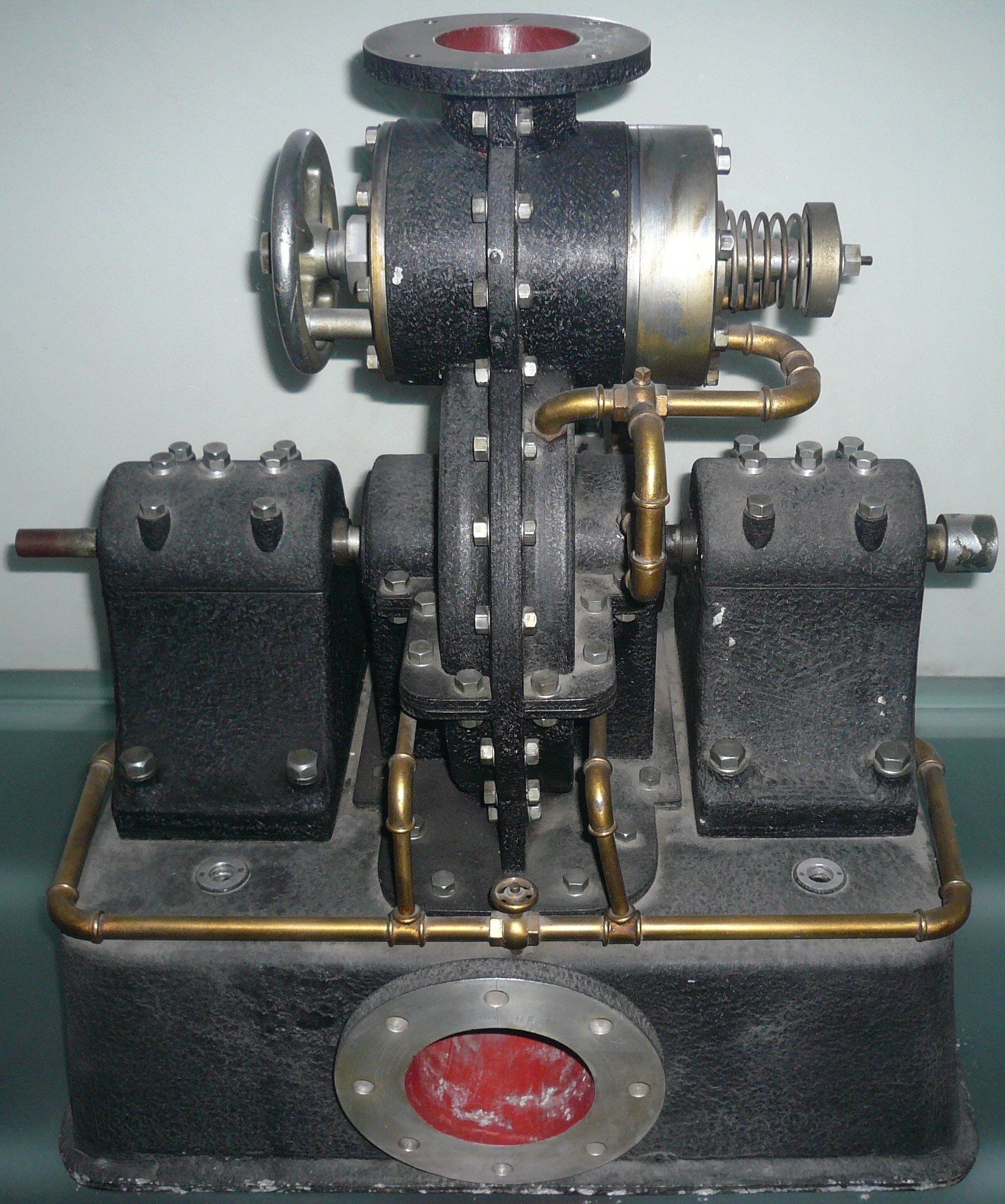
    Nikola Tesla's atmospheric air pressure powered Rotary Air Engine aka "Tesla Turbine"

    Add the air valve from his later patent 1,329,559 and use either of these methods to start the turbine by creating a vacuum.

    1. Manual or electric vacuum pump
    2. Fuel & spark
    3. High pressure air or water, fluid or gas
    4. Glow plug (my idea)

    It's all in the patents.

    Create a vacuum and the one way air valve will only allow atmospheric pressure in.

    The high internal vortex air being only able to exit the exhaust ports which instantly increases the vacuum.

    The magic ingredient is the "almost frictionless bearings. Tesla used air bearings powered by the devices own vacuum! How clever is that!

    Magnetic bearings are also favourable providing they are stable.

    Go to 2:25 in the video.
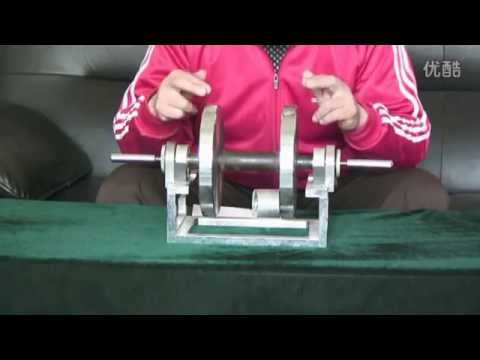


    It's Tesla's best design for a controllable tornado in a box and he hid it well from the right people but I was able to follow the Hansel & Gretel breadcrumb trail through his patents.

    Happy building folks!!!

    I'm a few weeks away from an awesome set of permanent magnetic bearings for this!
    Last edited by soundiceuk; 01-27-2020, 02:21 PM.

  • #2
    What a genius invention! Tesla hid the truth between 8 patents.

    The turbine is designed to run on the heat in atmospheric air.

    A vacuum hand primer connected between the one way valve and the turbine is the easiest method used to start the turbine.

    It is like a car engine only with atmospheric air as fuel and it is constantly on power stroke with no moving valves.

    Once a vacuum is created it makes its own vacuum from the volume of air leaving the exhaust ports.

    Basic Principle Videos:


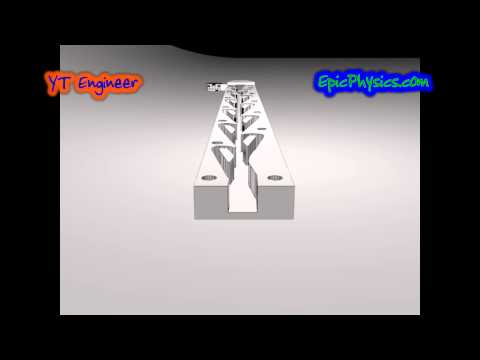
    Tesla One Way Air Diode:


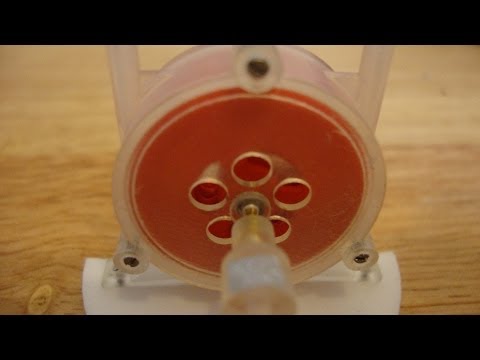
    Tesla Turbine:


    Watch what happens when it gets to 50,000RPM

    Bare in mind it has no permanent magnetic bearings, one way air diode, no vacuum applied to exhaust instead of using compressed air.

    I've got loads more research on this but thought I would start the ball rolling by spreading the news!

    Cheers,

    Paul
    Last edited by soundiceuk; 01-27-2020, 02:22 PM.

    Comment


    • #3
      Ok guys, seriously what are doing messing around with any other technology?

      Tesla has given us the greatest gift possible.

      I am the whistleblower.

      The Tesla turbine runs on air!

      It is single stroke engine!

      Power stroke!

      It's moves atmospheric air pressure to lower air pressure through the turbine.

      In doing so it makes it own vacuum.

      I can provide all the references written by Tesla spreading over 9 patents.

      Tesla left a Hansel and Gretel trail and I happened to find it in my search for the ultimate magnetic bearing design.
      Last edited by soundiceuk; 01-27-2020, 02:23 PM.

      Comment


      • #4
        Have you ever stopped to think about why when you open a door another door violently slams shut?

        You created a vacuum and the high pressure warm air rapidly flows to the colder low pressure air.

        This movement shoved a large portion of air out of the door that creates a vacuum which is why the door slams violently.

        Using a Tesla turbine and a Tesla valve we can harness this naturally occurring phenomenon.
        Last edited by soundiceuk; 02-09-2021, 04:39 PM.

        Comment


        • #5
          Hi folks, one of the methods I discovered whilst on my research travels was printing patents out in A3.

          It allows me to look at them longer without eye strain and I am able to go into a meditative state while reading them.

          The eye strain of A4 makes me lose concentration and get tired quickly.


          Valvular Conduit Patent 1,329,559

          1. Line 76

          Page 1 "Fig 4 is a plan showing the manner in which the invention is, or may be used, to operate a fluid propelled rotary engine or turbine"

          2. Page 2 - All of Line 75 - 84

          3. Page 3 - Line 28 "Fig 4. exemplifies a particularly valuable application of the invention to which reference has been made above. The drawing show in vertical cross section a turbine which may be of any type but is in this instance one invented and described by me"

          4. Page 3 - Line 79 "Its use, however, while advantageous, is not indispensable the suction produced by the turbine rotor itself being, in some cases at least, sufficient to insure proper working. This detail is omitted from the drawing as unessential to the understanding"

          5. Page 3 - Line 96 "Upon the subsidence of the explosion the pressure in the chamber sinks below the atmospheric owing to the pumping action of the rotor or ventilator and new air and gas is permitted to enter, cleaning the cavity and channels and making up a fresh mixture"

          6. Page 3 - Line 105 "After a short lapse of time the chamber becomes heated to such a degree that the ignition may be shut off without disturbing the established regime.

          7. Page 3 - Line 117 "When the chamber is small an auxiliary means for starting, as compressed air, may be resorted to"

          8. Page 4 - Line 12 "provision made for maintaining a vacuum at the exhaust"

          9. Page 4 - Line 31 "I do not claim the methods of and apparatus for the propulsion of fluids and thermodynamic transformation of energy herein disclosed, as these will be made subjects of separate applications"


          I've got some more to add to this but here is my rough list for this patent.

          Cheers,

          Paul

          Comment


          • #6
            Tesla's New Monarch of Machines

            by Nikola Tesla


            "Tesla's New Monarch of Machines"

            TESLA ENGINE BOOK


            New York Herald

            Oct. 15, 1911

            Comment


            • #7
              Ten Horse Power to the Pound.

              Comment


              • #8
                Nikola Tesla - US Patent 1,655,113 - 1927

                Apparatus For Aerial Transportation


                This is Tesla's first flying machine patent. It seems that every patent that made it out there after Wardenclyffe was destroyed, was a puzzle piece to Tesla's turbine and ultimately his flying machine.


                CLUES:

                1. Well firstly, no fuel tank in the diagram
                2. Page 3 - Line 81

                "To accomplish this a light and powerful prime mover is necessary and as particularly suited for the purpose I employ, preferably, a turbine of the kind described in my US patent 1,061,206, of May 6, 1913, which not only fulfills these requirements, but is especially adapted to operation at high temperatures."

                3. Page 3 - Line 106

                "The motors 2, 2 in this case turbines of the kind described in my patent before referred to"

                4. Page 4 - Line 3

                "At the start, sufficient power being turned on by suitable means, also within his reach"

                5. Page 4 - Line 47

                "Evidently also, whenever necessary or desirable, power far in excess of that normally required may be applied during flight and the machine propelled at a greatly increased speed. The type of turbine used is a motor of great lightness and activity and lends itself exceptionally to this kind of work for which ordinary aviation motors are unsuited.

                It is capable of carrying a great overload and running without danger at excessive speed so that during the starting and landing operations the necessary power can be developed by the motors even though less efficiently than under their normal working conditions"

                6. Page 4 - Line 81

                "Especially good practical results are obtainable by use of my turbine which can be depended upon to develop the necessary energy for lifting, even if it should be considerably greater than that consumed in flight under normal conditions. This end can be conveniently attained by temporarily supplying more of the working fluid to the rotor and driving it faster"

                I'm still pulling apart other patents.

                What is interesting is the following patent 1,655,114 which I will pull apart for you next.

                Cheers,

                Paul

                Comment


                • #9
                  A LIGHTING MACHINE ON NOVEL PRINCIPLES
                  - by Nikola Tesla

                  A machine built on novel and original lines is about to be placed on the market. It consists of a turbine and electric generator, both employing basically new principles in construction as well as operation, and intimately associated to constitute a unit. The former has been pronounced revolutionary in its design and performance. It is simplicity itself, being devoid of buckets, deflecting blades, guide passages, vanes and the like, and presents many other decisive advantages over the ordinary prime mover.

                  In the first place there is no windage, which is the cause of a most serious loss of power in bucket turbines, often amounting to a large percentage of the integral mechanical effort. What is still more important, the new turbine is capable of taking up the whole velocity of the motive fluid in one continuous process, thus saving the expense and avoiding the complication incident to "staging". Furthermore, it has the precious quality of transforming into useful work frictional energy irretrievably spent in other heat motors.

                  The corrosion and erosion of buckets and vanes in the present turbines is the cause of another great and irremediable waste of energy, the water rate frequently increasing 30% to 40% after but a few months of use. No such hurtful actions exist in the new turbine, and if they did, they would not impair the performance to any appreciable degree. Again, the former are subject to considerable loss owing to unpreventable wear and deterioration of the nozzles. It is essential that the high velocity streams of fluid issuing from them be directed upon the curved blades with great precision, as a failure of this is fatal to good results. To such an extent is this the case that even a slight roughening of the polished surfaces will reduce the useful energy as much as 25%. The new turbine is entirely free from this defect. However the nozzle may be used up, the fluid is made to flow through the wheel smoothly and evenly in natural stream lines, transmitting power to the same with undiminished efficiency. Another feature of superiority is found in its adaptability to high temperatures far beyond those practicable in bucket turbines. For every hundred degrees of increase in temperature, the steam consumption is reduced from 10% to 12%. Great economies are thus made possible by the use of the new prime mover.

                  In every turbine the device regulating the speed of rotation and controlling the admission of the working fluid to the nozzles is of vital importance. With scarcely an exception it is of the centrifugal type driven from the shaft in some or other way and constituting an assemblage of gears, flying weights, links, levers, sleeves, thrust bearings and other parts. It is an apparatus complex and delicate, expensive to construct and easily deranged, often with disastrous consequences. All this has been done away in the new turbine which is controlled in a novel and striking manner. The regulator is elementary in its construction, positive and unfailing in its action, and yet so sensitive as to respond to variations of load amounting to less than 1% of the normal. This simple device is rendered still more valuable by the fact that it adjusts itself instantaneously to pressure changes so that the effects of these on the lamps are inappreciable. To illustrate, the steam gauge on the boiler may indicate fluctuations from 100 to 200 pounds or more and following each other however rapidly without the slightest observable change in the intensity of the light. This remarkable action of the device is independent of its function as regulator of speed.

                  Another advantage deserving the most careful consideration of the user is the perfect safety of the new turbine. There is an ever present danger in a machine of the old type, that the wheel might burst and destroy life and property. Such a deplorable accident is absolutely impossible with the new turbine rotor, composed of thin discs which expand slightly and come to rest, invariably without damage, as has been shown in exhaustive experiments.

                  The one feature, however, which has most amazed experts, is the extraordinary power of this form of prime mover. Owing to the great effectiveness of the underlying principle and peculiar construction, ten times more power can be produced than with any other machine known. For example, a rotor of 9" in diameter, weighing less than 20 pounds, can readily develop 200 brake horsepower, and this is by no means the limit of performance.

                  But the merits of this lighting outfit do not rest on the turbine alone. The dynamo associated with the same is perhaps equally noteworthy by its simplicity of construction, high efficiency and rare and valuable properties it possesses. It consists of a smooth cylindrical body mounted on the turbine shaft and arranged to rotate within a magnetic field of novel forma There is no brush or sliding contact whatever, the current being taken from stationary terminals to which the ends of the generating coils are connected. By employing the best materials and workmanship and resorting to artifices of design, a most economical electrical generator is produced, the efficiency being over 90% even in machines of very small size having rotors of not more than 2 1/2" in diameter. This generator possesses extraordinary qualities, especially desirable in electric lighting. It is capable of furnishing a current constant within a minute fraction of 1% through a very wide range of speed variation, and as such is ideally suited for running arc lamps or kindred electrical devices in series. More surprising still and also of greater commercial import is its capability of maintaining a constant potential. Such results as are obtainable with it are wholly impossible with other types of electrical generators. It has been found in practice that all lamps but one can be turned off suddenly without the slightest perceptible flicker and even without any observable effect on the needle of a delicate instrument indicating the voltage.

                  That an apparatus of such simplicity and presenting so many salient advantages should find an extensive use in electric lighting might be naturally expected, but its overwhelming superiority will be better appreciated when it is stated that it occupies hardly more than one-tenth of the space of apparatus of the usual forms and weighs less in proportion. A machine capable of developing 1-kilowatt, for instance, goes into a space of 8 x 8 x 10" and weighs but 40 pounds. It takes not more than one-third of the steam consumed in other turbo-generators of that size.

                  The guiding idea in the development of this new machine was to evolve a mechanism approximating a static transformer of energy in simplicity, efficiency and reliability of operation. Every detail has been worked out with this object in view. There is no exciter, no commutator, brush or sliding contact whatever, no centrifugal regulator, voltage controller or any such complicated and hazardous device. The machine consists of but a stationary solid frame and two smooth cylindrical steel bodies mounted on a strong shaft arranged to rotate in bearings virtually frictionless. No oiling is required, although a small quantity of lubricant is provided rather as a precaution than necessity. A perfect dynamic balance is secured in a novel manner and insures a steady and quiet running without tremor and vibration. The whole apparatus can be boxed up and depended upon to operate uninterruptedly through long periods of time. The outfit can be constructed in various sizes up to 100-kilowatt or more, and should meet more satisfactorily than any yet devised the varied requirements of electric lighting on railroads, boats, in public buildings, factories and mines, and may also be advantageously utilized in connection with existing plants for replacing belt driven dynamos and storage batteries, and relieving larger engines through the night and hours of small load.

                  Comment


                  • #10
                    increased efficiency

                    Hi Paul,

                    This guy's comments in YouTube seem to make sense on the surface.
                    Aaron

                    [VIDEO]https://www.youtube.com/watch?v=XVW44ZZa62Q[/VIDEO]


                    "I know the answer: This turbine uses the boundary layer effect. That is like friction that the air has with the surfaces inside- you know that part already. This type of friction has two modes: static and kinetic. Just as with a brick sliding on the floor, the coefficient of friction is much higher from stationary than when the brick is already moving. Hence, once the turbine gets to a high enough speed, the coefficient of friction increases and the motor becomes nearly 100% efficient. This is an over celebrated effect though, because the motor cannot be in this efficient zone if it is actually doing something useful. That's why bladed turbines are used in real world situations."

                    +Reginald Ford Hi, can you detail your point "This is an over celebrated effect though, because the motor cannot be in this efficient zone if it is actually doing something useful." ?

                    "Yes, Pedro, I'd love to go into detail. When the blades are going close (enough) to the speed of the incoming air, the RELATIVE speed of the air and the blades is low, hence, the STATIC coefficient of friction starts to take hold. This causes the blades to start going exactly the same speed as the incoming air, which is a rare 100% efficiency. If a load is on the turbine, this will not happen. So people are always running these Tesla turbines with no load, where they excel well: going fast and doing nothing useful. Loaded, though, they might not even turn at all! Hence, as I said, bladed turbines are the real world use. IF you get the tesla turbine to that 100% efficient zone, you may be able to connect a load WHILE it's spinning and gain a useful advantage, but if the load is too much, the kinetic coefficient of air friction comes in , and the turbine will become nearly useless again."


                    --------------------------------------


                    I don't know if it is just increasing efficiency or if the turbine is causing a suction that exceeds the pressure of the incoming air. If so, maybe in can feed itself at a high enough speed.


                    That guy posting that comment doesn't think it will happen under load. I don't know.


                    Maybe gear up a motor to spin the shaft of one at high speed while pumping water and see it at a certain speed the motor becomes unloaded. That might be a first basic test. Maybe some others with experience with Tesla Turbines can comment??
                    Last edited by Aaron; 11-21-2018, 09:40 PM.
                    Sincerely,
                    Aaron Murakami

                    Books, Videos, ESTC Conference Info, Blog, etc. https://emediapress.com

                    Comment


                    • #11
                      Originally posted by Aaron View Post
                      That guy posting that comment doesn't think it will happen under load. I don't know.
                      "A pressure/friction device that operates with a potential difference. If you used the turbine as an energy storage device ( flywheel storage ) then the magnetic / air bearings would make sense. A 200 lb flywheel, 3ft in diameter spinning at 50,000 rpm would supply a 95 hp ( over 70,000 watts ) output for 41 minutes. Run a bank of them with some being charged while others are being discharged and you have a power station."

                      Taking a load will slow down the turbine a little.

                      Just like a fly would slow down a train!

                      Depends on how big the load I guess!

                      Comment


                      • #12
                        Tesla wasn't using magnetic bearings, he was using air bearings powered by atmospheric pressure.


                        Last edited by soundiceuk; 01-27-2020, 02:24 PM.

                        Comment


                        • #13
                          Also the load is drawn off the 2nd stage low RPM turbine while the 1st stage turbine retains high RPMs.

                          Comment


                          • #14
                            BOUNDARY-LAYER BREAKTHROUGH

                            THE TESLA BLADELESS DISK TURBINE

                            INTRODUCTION:

                            Most people remember Nikola Tesla for his work and revelations in the field of electrical energy and the invention of radio. However, Tesla had a life long interest in developing a flying machine. Tesla had envisioned himself as the first man that would fly. He had planned to build an aircraft that would operate on electric motors. However, the first men who successfully flew an aircraft used the reciprocating internal combustion engine. Though successful in achieving flight, aircraft using these engines were dangerous and unpredictable, due to the engine's lack of adequate power. Tesla turned his attention to revamping the internal combustion engine so as to make flying safe for all and minimize its environmental impact. Documented in this text is the result of Tesla's endeavors and the resulting marvel of machines called the Bladeless Boundary- Layer Turbine.

                            Although Tesla's dream for his engines application in aircraft was not realized in his life time, if allowed to be used in aircraft today, it would provide a quiet, safe, simple and efficient alternative to our supposedly advanced bladed turbine aircraft engines. It has been estimated that an increase in fuel efficiency of a factor of three could be realized in aircraft and thus substantially reduce pollution. Not only this, the Bladeless Tesla Turbine Engine can turn at much higher speeds with total safety. If a conventional bladed turbine engine goes critical or fails, watch out, you have exploding parts slicing through hydraulic lines, control surfaces and maybe even you. With the Bladeless Tesla Turbine this is not a danger because it will not explode. If it does go critical, as has been documented in tests at 85,000 rpm, the failed component will not explode but implode into tiny pieces which are ejected through the exhaust while the undamaged components continue to provide thrust to keep you airborne. We. can only speculate on the human suffering that could and should be averted.

                            The application of this amazing engine was not to be limited to aircraft. Tesla was setting up plans to replace what he considered the wasteful, polluting, inefficient and complicated reciprocating engine in all its applications, including the automobile. Tesla's small but powerful engine has only one moving part and is 95% efficient, which means tremendous mileage. It runs vibration free and doesn't even require a muffler. Not only is this engine 95% efficient, as compared to 25% efficiency or less of the conventional gas engine, it can run efficiently on any fuel from sawdust to hydrogen with no wear on the internal engine components. This engine's speed-torque characteristic allows full torque at the bottom of the speed range eliminating the conventional shifting gear transmission. This provides additional economy as the expensive, complicated and wear prone transmission is eliminated.

                            Unlike most people of the time, Tesla was very concerned about the long range environmental damage the reciprocating engines would create. He stressed over and over how we must take the long range view and not step out of harmony with our life support systems. Today the widening concern for Spaceship Earth and the renewal of an old ethic "We don't inherit the Earth from our ancestors, we borrow it from our children" is slowly beginning to awaken people to the concerns of Tesla.

                            Although the existence of the automobile on city streets dates back to the first years of the century, its role as a contributor to air contamination did not receive wide acceptance among scientists until the 60's. Factual evidence that urban area smog was chemically related to automobile emissions had been produced and acknowledged by scientific groups in the 1950's. Despite vehement disagreement which ensued between government and the automotive industry on this volatile issue, research and development programs were initiated by both groups in an effort to identify the reciprocating internal combustion engine's sources of pollution and determine what corrective action might be taken. Obviously Tesla's ounce of prevention was not heeded, leaving us with well over the pound required for a cure with nearly half of all air pollution caused by the reciprocating internal combustion engine.

                            The Boundary Layer Turbine is not only an engine that is hard to comprehend by our currently imposed standards, but can also be used as a pump with slight modification. And like its cousin the engine, it has Herculean power. Unlike conventional pumps that are easily damaged by contaminants, the Bladeless Tesla Pump can handle particles and corrosives in stride as well as gases with no cavitation effect that destroys, in short order, conventional type pumps.

                            These pumps and engines, though unknown to most, are available for commercial sale. If large scale commercial production was implemented, these engines and pumps would be extremely affordable due to their simplicity of manufacture, longevity, almost total lack of maintenance and the added bonus that they require no crank case oil.

                            Almost a quarter of the air pollution today comes from the coal being burned to generate electricity. Fuel consumption, resulting in air pollution and acid rain, could be significantly reduced simply by replacing the conventional blade steam turbines currently used by utilities with the Bladeless Tesla Steam Turbine. This also would have the added bonus of drastically reducing maintenance. But the real solution lies in using low temperature wet steam occurring naturally from the ground in the form of geothermal energy. This energy would destroy a conventional bladed steam turbine, unless expensive steam drying is employed. However, the Bladeless Tesla Steam Turbine requires no drying and can be connected directly to the geothermal source. It has been estimated that the geothermal potential in just Southern California alone, could power the entire North American Continent with NO POLLUTION! Large oil companies have comprehended the potential of geothermal energy and have purchased many of these large tracks of prime geothermal land.

                            Due to the revolutionary concepts embodied in this engine, we can easily end the so called energy crisis and dramatically reduce pollution. Even the vested energy interests are beginning to understand that now is the time for change, realizing their future health and wealth is directly linked to that of the environment. You can't hide or buy your way out of a devastated planet. There must also be a move forward for the many misinformed environmentalists who see our future as one of regression from technology instead of its proper usage.

                            Tesla from his 1919 autobiography, My Inventions: "My alternating system of power transmission came at a psychological moment, as a long-sought answer to pressing industrial questions, and although considerable resistance had to be overcome and opposing interests reconciled, as usual, the commercial introduction could not be long delayed. Now, compare this situation with that confronting my turbine, for example. One should think that so simple and beautiful an invention, possessing many features of an ideal motor, should be adopted at once and, undoubtedly, it would under similar conditions. But the prospective effect of the rotating field was not to render worthless existing machinery; on the contrary, it was to give it additional value. The system lent itself to new enterprise as well as to improvement of the old. My turbine is an advance of a character entirely different. It is a radical departure in the sense that its success would mean the abandonment of the antiquated types of prime movers on which billions of dollars have been spent. Under such circumstances the progress must needs be slow and perhaps the greatest impediment is encountered in the prejudicial opinions created in the minds of experts by organized opposition."

                            H.G. Wells once said that future history will be a race between education and catastrophe. This book is dedicated to the race for education. Reprinted from: Boundary-Layer Breakthrough - The Tesla Bladeless Turbine pages 114-118.

                            Scientific American September 30, 1911, page 290

                            From the Complex to the Simple

                            A MARKED step was taken in the simplification of prime movers when Watt's cumbersome beam engine, with its ingenious but elaborate parallel motion, gave way to the present standard reciprocating type, with only piston rod, cross head and connecting rod interposed between piston and crank. An even greater advance toward ideal simplicity occurred when, after years of effort by inventors to produce a practical rotary, Parsons brought out his compact, though costly, turbine, in which the energy of the steam is developed on a zig-zag path through multitudinous rows of fixed and moving blades.

                            And now comes Mr. Tesla with a motor which bids fair to carry the steam engine another long step toward the ideally simple prime mover - a motor in which the fixed and revolving blades of the turbine give place to a set of steel disks of simple and cheap construction. If the flow of steam in spiral curves between the adjoining faces of flat disks is an efficient method of developing the energy of the steam, the prime mover would certainly appear to have been at last reduced to its simplest terms.

                            The further development of the unique turbine which we describe elsewhere will be followed with close attention by the technical world. The results attained with this small high-pressure unit are certainly flattering, and give reason to believe that the addition of a low pressure turbine and a condenser would make this type of turbine as highly efficient as it is simple and cheap in construction and maintenance.

                            Comment


                            • #15
                              Scientific American September 30, 1911, page 296

                              The Rotary Heat Motor Reduced to its Simplest Terms

                              It will interest the readers of the Scientific American to that Nikola Tesla, whose reputation must, naturally, stand upon the contribution he made to electrical engineering when the art was yet in its comparative infancy, is by training and choice a mechanical engineer, with a strong leaning to that branch of it which is covered by the term "steam engineering." For several years past he has devoted much of his attention to improvements in thermo-dynamic conversion, and the result of his theories and practical experiments is to be found in an entirely new form of prime movers shown in operation at the waterside station of the New York Edison Company, who kindly placed the facilities of their great plant at his disposal for carrying on experimental work.

                              By the courtesy of the inventor, we are enabled to publish the accompanying views, representing the testing plant at the Waterside station, which are the first photographs of this interesting motor that have yet been made public. The basic principle which determined Tesla's investigations was the well-known fact that when a fluid (steam, gas or water) is used as a vehicle of energy, the highest possible economy can be obtained only when the changes in velocity and direction of the movement of the fluid are made as gradual and easy as possible. In the present forms of turbines in which the energy is transmitted by pressure, reaction or impact, as in the De Laval, Parsons, and Curtiss types, more or less sudden changes both of speed and direction are involved, with consequent shocks, vibration and destructive eddies. Furthermore, the introduction of pistons, blades, buckets, and intercepting devices of this general class, into the path of the fluid involves much delicate and difficult mechanical construction which adds greatly to the cost both of production and maintenance.

                              The desiderata in an ideal turbine group themselves under the heads of the theoretical and the mechanical. The theoretically perfect turbine would be one in which the fluid was so controlled from the inlet to the exhaust that its energy was delivered to the driving shaft with the least possible losses due to the mechanical means employed. The mechanically perfect turbine would be one which combined simplicity and cheapness of construction, durability, ease and rapidity of repairs, and a small ratio of weight and space occupied to the power delivered on the shaft. Mr. Tesla maintains that in the turbine which forms the subject of this article, he has carried the steam and gas motor a long step forward toward the maximum attainable efficiency, both theoretical and mechanical. That these claims are well founded is shown by the fact that in the plant at the Edison station, he is securing an output of 200 horse-power from a single-stage steam turbine with atmospheric exhaust, weighing less than 2 pounds per horse-power, which is contained within a space measuring 2 feet by 3 feet, by 2 feet in height, and which accomplishes these results with a thermal fall of only 130 B.T.U., that is, about one-third of the total drop available. Furthermore, considered from the mechanical standpoint, the turbine is astonishingly simple and economical in construction, and by the very nature of its construction, should prove to possess such a durability and freedom from wear and breakdown as to place it, in these respects, far in advance of any type of steam or gas motor of the present day.

                              Briefly stated, Tesla's steam motor consists of a set of flat steel disks mounted on a shaft and rotating within a casing, the steam entering with high velocity at the periphery of the disks, flowing between them in free spiral paths, and finally escaping through exhaust ports at their center. Instead of developing the energy of the steam by pressure, reaction, or impact, on a series of blades or vanes, Tesla depends upon the fluid properties of adhesion and viscosity--the attraction of the steam to the faces of the disks and the resistance of its particles to molecular separation combining in transmitting the velocity energy of the motive fluid to the plates and the shaft.

                              By reference to the accompanying photographs and line drawings, it will be seen that the turbine has a rotor A which in the present case consists of 25 flat steel disks, one thirty-second of an inch in thickness, of hardened and carefully tempered steel. The rotor as assembled is 3 1/2 inches wide on the face, by 18 inches in diameter, and when the turbine is running at its maximum working velocity, the material is never under a tensile stress exceeding 50,000 pounds per square inch. The rotor is mounted in a casing D, which is provided with two inlet nozzles, B for use in running direct and B' for reversing. Openings C are cut out at the central portion of the disks and these communicate directly with exhaust ports formed in the side of the casing.

                              In operation, the steam, or gas, as the case may be is directed on the periphery of the disks through the nozzle B (which may be diverging, straight or converging), where more or less of its expansive energy is converted into velocity energy. When the machine is at rest, the radial and tangential forces due to the pressure and velocity of the steam cause it to travel in a rather short curved path toward the central exhaust opening, as indicated by the full black line in the accompanying diagram; but as the disks commence to rotate and their speed increases, the steam travels in spiral paths the length of which increases until, as in the case of the present turbine, the particles of the fluid complete a number of turns around the shaft before reaching the exhaust, covering in the meantime a lineal path some 12 to 16 feet in length. During its progress from inlet to exhaust, the velocity and pressure of the steam are reduced until it leaves the exhaust at 1 or 2 pounds gage pressure.

                              The resistance to the passage of the steam or gas between adjoining plates is approximately proportionate to the square of the relative speed, which is at a maximum toward the center of the disks and is equal to the tangential velocity of the steam. Hence the resistance to radial escape is very great, being furthermore enhanced by the centrifugal force acting outwardly. One of the most desirable elements in a perfected turbine is that of reversibility, and we are all familiar with the many and frequently cumbersome means which have been employed to secure this end. It will be seen that this turbine is admirably adapted for reversing, since this effect can be secured by merely closing the right-hand valve and opening that on the left.

                              It is evident that the principles of this turbine are equally applicable, by slight modifications of design, for its use as a pump, and we present a photograph of a demonstration model which is in operation in Mr. Tesla's office. This little pump, driven by an electric motor of 1/12 horse-power, delivers 40 gallons per minute against a head of 9 feet. The discharge pipe leads up to a horizontal tube provided with a wire mesh for screening the water and checking the eddies. The water falls through a slot in the bottom of this tube and after passing below a baffle plate flows in a steady stream about 3/4 inch thick by 18 inches in width, to a trough from which it returns to the pump. Pumps of this character show an efficiency favorably comparing with that of centrifugal pumps and they have the advantage that great heads are obtainable economically in a single stage. The runner is mounted in a two-part volute casing and except for the fact that the place of the buckets, vanes, etc., of the ordinary centrifugal pump is taken by a set of disks, the construction is generally similar to that of pumps of the standard kind.

                              In conclusion, it should be noted that although the experimental plant at the Waterside station develops 200 horse-power with 125 pounds at the supply pipe and free exhaust, it could show an output of 300 horse-power with the full pressure of the Edison supply circuit. Furthermore, Mr. Tesla states that if it were compounded and the exhaust were led to a low pressure unit, carrying about three times the number of disks contained in the high pressure element, with connection to a condenser affording 28 1/2 to 29 inches of vacuum, the results obtained in the present high-pressure machine indicate that the compound unit would give an output of 600 horse-power, without great increase of dimensions. This estimate is conservative.

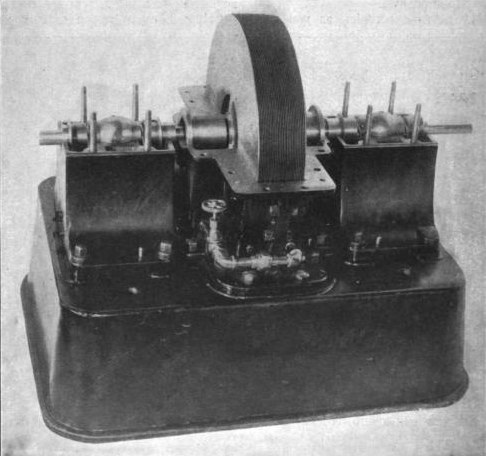
                              The testing plant consists of two identical turbines connected by a carefully calibrated torsion spring, the machine to the left being the driving element, the other the brake. In the brake element, the steam is delivered to the blades in a direction opposite to that of the rotation of the disks. Fastened to the shaft of the brake turbine is a hollow pulley provided with two diametrically opposite narrow slots, and an incandescent lamp placed inside close to the rim. As the pulley rotates, two flashes of light pass out of the same, and by means of reflecting mirrors and lenses, they are carried around the plant and fall upon two rotating glass mirrors placed back to back on the shaft of the driving turbine so that the center line of the silver coatings coincides with the axis of the shaft. The mirrors are so set that when there is no torsion on the spring, the light beams produce a luminous spot stationary at the zero of the scale. But as soon as load is put on, the beam is deflected through an angle which indicates directly the torsion. The scale and spring are so proportioned and adjusted that the horse-power can be read directly from the deflections noted. The indications of this device are very accurate and have shown that when the turbine is running at 9,000 revolutions under an inlet pressure of 125 pounds to the square inch, and with free exhaust, 200 brake horse-power are developed. The consumption under these conditions of maximum output is 38 pounds of saturated steam per horse-power per hour - a very high efficiency when we consider that the heat-drop, measured by thermometers, is only 130 B.T.U., and that the energy transformation is effected in one stage. Since about three times this number of heat units are available in a modern plant with super-heat and high vacuum, the above means a consumption of less than 12 pounds per horse-power hour in such turbines adapted to take up the full drop. Under certain conditions, however, very high thermal efficiencies have been obtained which demonstrate that in large machines based on this principle, in which a very small slip can be secured, the steam consumption will be much lower and should, Mr. Tesla states, approximate the theoretical minimum, thus resulting in nearly frictionless turbine transmitting almost the entire expansive energy of the steam to the shaft.

                              BOUNDARY-LAYER BREAKTHROUGH [3] - THE TESLA BLADELESS TURBINE

                              Journey back to the future and discover the fascinating secret behind the most powerful and economic internal or external combustion engine of all time: Tesla's Bladeless Boundary-Layer Turbine. You will experience the excitement of understanding as Tesla's mechanical breakthrough is explored, shattering the boundaries of our current mechanical standard. You will be swept into the awareness of discovery as the simplicity of this whirl wind machine of natural harmony is revealed. Unveiled here today how it is possible to convert the normally undesired energy of drag into the tremendous vortex energy of Tesla's perfectly controlled mechanical tornado. The real answer to energy.

                              Comment

                              Working...
                              X